Running Traveller - Part 1: Prep
The Referee reads books and blogs, and rolls dice to create planets.
I am running classic Traveller for my regular rpg group, and I’m very excited. After picking up The Traveller Book last year and reading it cover to cover, I was more than surprised to learn that classic Traveller is not the watered down sci-fi rpg that I thought it was.
Also with some hindsight, I’m glad I only discovered it last year and not a few years ago. Having absorbed and expelled Mothership and more than a few other OSR games out of my system, I can approach Traveller with a much clearer eye for what I want out of a game. There would have been a time in my life when I would read it and found it more interesting than good and likely never run it!
Blogs
I was already aware of several blogs extolling the virtues of classic Traveler, including The Four Legs, Traveller out of the Box, and Michael H's session reports.
I won’t repeat all these ideas here but while I did find them interesting and I’m glad to have read them through, not all of it is strictly necessary. What I got out of this research is: lean on the encounter tables both to create unusual events and spark your imagination, make sure your players are tight on money or resources, and employ OSR principles of running games.
One highlight especially is the situation throw, which really clicked a lot of the game together in my mind. Classic Traveller famously does not have a unified check resolution mechanic. The simplest it gets is combat, wherein various modifiers are added to 2d6 roll with a success threshold of 8+. But in using various skills sometimes the referee should create their own success threshold, or throw 2d6 under a characteristic, etc.
The situation throw basically makes the whole game a ‘roll versus’ style, where the world is rolling against the player. Sometimes fixing a fuel leak is easy, sometimes crash-landing an air/raft is hard. Sometimes the referee will be able to come up with a reasonable difficulty for a check, but I foresee myself using the situation throw a lot to get some kind of friction for the players and then think about various modifiers for their roll.
Books
Another aspect of preparing for classic Traveller is understanding the kind of sci-fi it is best suited for. Despite what the book and blogs above say, Traveller is best suited to pulpy adventure sci-fi. I read the The Winds of Gath, Space Viking, and City of the Chasch to get the right kind of pulp in my head, which was as useful as understanding how important the ship mortgage rules are (very).
Traveller makes a very big sci-fi conceit straight away: travel is faster-than-light, but communication is not. So information and trade happen at speed of travel, which can be slow! You cannot have a real-time conversation with someone in another star system. So this produces a high variety of worlds and technologies represented in those adventure books and the technology levels of the game.
Far from being a hard sci-fi game where all of human progress is measured, it’s a picaresque adventure where planet hopping rogues are trying to swindle a pre-industrial civilization out of their precious jewels, or whatever. You can see shades of Star Wars or Star Trek here, but I think to say Traveller is a universal fit to any sci fi is actually a disservice to the very interesting sci fi it’s already representing.
Worlds
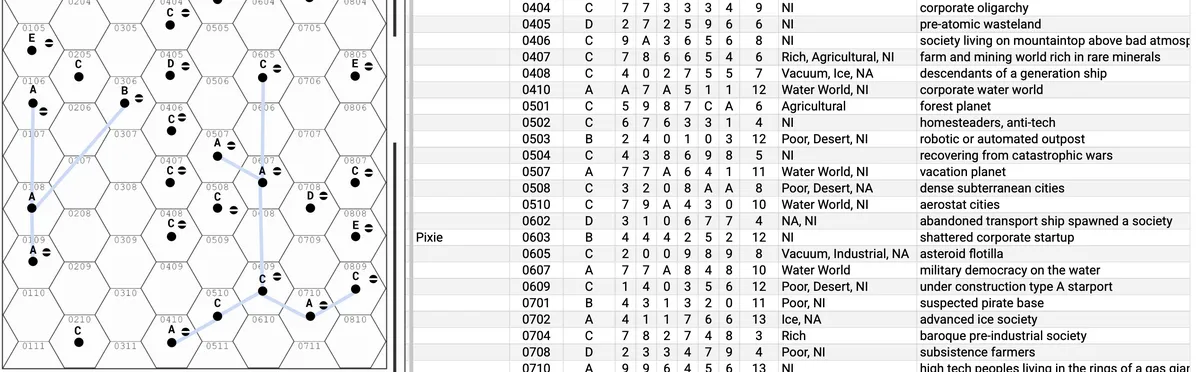
The majority of my prep was creating a subsector for the players. It is quite an involved process that takes several hours to complete, but if you are a sicko like me you won’t feel that time at all.
Some of the decisions the game makes here are very interesting! Once you get past the straightforward physical characteristics, the political and social dynamics of these planets can become really unique.
What does it mean for a planet to be a complete water-world, have a few thousand people on it ruled by a corporation with no laws and very high technology? Or a tiny airless and waterless rock with millions of inhabitants and flourishing industry? Ten people with high tech and anarchic government?
I tried my best to answer these questions with a ‘simple description’ of the kind the players might get when they arrived in the system. “Oh those are some weird homesteaders, oh that might be a pirate base, oh that’s a colony of this other planet” and so on. The world generation system really put my imagination to the test, but we have forty-ish pretty unique planets to play around in and I had a lot of fun making them.
A few active decisions I made here plus some random outcomes led to a very fun character creation session.